
SLAM TANK’s Moving Weapon: How Melee Combat Transforms the Meaning of a Tank
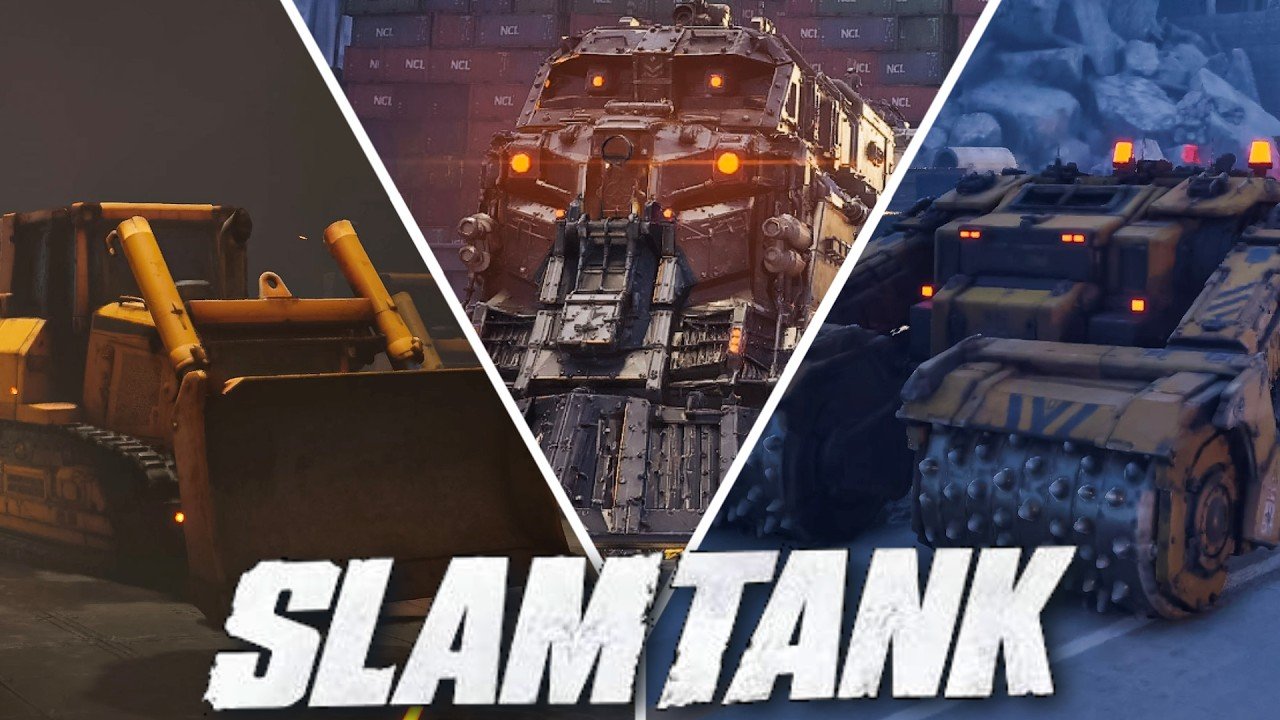
A tank’s cannon usually establishes a relationship between distance and power: the vehicle positions itself, identifies a target, and projects destructive force across the battlefield. SLAM TANK rearranges that relationship by making physical contact central to its identity. Its developer describes a machine that swings its cannon barrel, rotates its turret into attacks, and drives directly through enemy formations. These actions suggest a particular subject worth examining closely: the transformation of an armored vehicle into a melee combatant whose movement becomes part of its weaponry. The interesting question is not simply why a tank would strike enemies with its barrel. It is what happens to combat, space, and the fantasy of mechanical power when the entire vehicle becomes an instrument of impact.
This article follows that idea through the implied sequence of an encounter, from recognizing the tank’s unusual body to approaching enemies, making contact, moving through resistance, and interpreting the resulting destruction. As of October 23, 2026, SLAM TANK has a Steam demo, while the full game’s release date remains unannounced. The discussion below is a design analysis of its publicly described mechanics, rather than a review claiming firsthand experience or knowledge of its complete campaign. Confirmed features provide the foundation; interpretations explore what those features mean when considered together.
1. Before the First Collision: Reimagining the Tank’s Body
The cannon becomes an arm
The first conceptual change happens before an enemy takes damage. A cannon barrel ordinarily directs attention toward its opening: it matters because something destructive emerges from the end. SLAM TANK’s barrel-swinging premise redirects attention toward the weapon’s entire length. Suddenly, the space beside the cannon matters as much as the space directly in front of it. The turret becomes a joint, the barrel resembles an extended limb, and the hull provides the moving foundation that carries both. This is an interpretive shift rather than a claim about a particular animation system. A familiar military silhouette begins to communicate bodily action. The player can imagine reach, rotation, contact, and follow-through using an object whose conventional purpose encourages very different expectations.
A machine understood through contact
That reinterpretation gives the tank an unusual kind of personality. A vehicle that attacks primarily through distant effects can remain visually detached from the consequences of its actions. A vehicle that physically swings into opposition exposes its own form during the attack. Its proportions become expressive because they define the apparent relationship between attacker and target. A long barrel communicates reach; a broad hull communicates presence; a rotating turret communicates potential movement around a central axis. These visual meanings do not establish exact hitboxes or damage calculations, which the available descriptions do not explain. They establish something more immediate: an understandable connection between the machine’s shape and its aggressive behavior. The tank appears capable of acting through its body, rather than merely transporting a weapon.
The result is a productive tension between rigidity and expression. Armor suggests a solid object, yet melee action asks that object to perform gestures. A human fighter communicates intent through shoulders, feet, and posture; SLAM TANK’s premise invites comparable attention to orientation, turning, and approach. Its absurdity therefore serves a structural purpose. The barrel strike makes the vehicle legible as an actor with a physical vocabulary. Before considering scoring, enemy variety, or spectacle, this is the foundation of the game’s particular appeal: a machine associated with controlled projection becomes a machine associated with direct bodily consequence. The tank’s recognizable shape gives the transformation meaning, because the player understands enough of its ordinary purpose to recognize the deliberate exaggeration.
2. The Approach: Distance Becomes a Dramatic Interval
Closing space changes the encounter
Once the tank is understood as a melee body, the distance between it and an enemy gains a different significance. In a ranged exchange, open ground can support attack without requiring either participant to cross it. A contact-centered encounter makes that same ground an interval of anticipation. The enemy is visible, but the tank has not yet reached the point where its physical presence can become destructive. SLAM TANK’s developer explicitly connects evading attacks, closing distance, and delivering barrel strikes against large industrial opponents. That description establishes approach as part of the combat sequence, rather than a neutral commute between moments of action. The journey toward the target participates in the encounter’s drama.
The promise of impact
The approach matters because impact has an observable future. A tank moving toward another machine creates an expectation that their positions will soon become incompatible. One object must yield, move away, or withstand the meeting. This gives motion a narrative quality without requiring dialogue or an elaborate story event. The player can read a small sequence of intentions: the tank commits to entering contested space, the opposition threatens that commitment, and contact resolves the immediate disagreement. The exact resolution depends on systems that cannot be inferred from promotional text alone. Nevertheless, the underlying attraction is clear. Forward movement can carry dramatic weight because it visibly brings the machine closer to the consequence of its own aggression.
This also changes the meaning of apparent vulnerability. Heavy armor might suggest that a tank can ignore danger, but contact-oriented action becomes more interesting when approaching a target involves exposure. The design question is how the game makes that exposure understandable. Too little resistance would reduce the approach to an inevitable prelude; unreadable resistance could make a collision feel arbitrary. Between those extremes lies the possibility of a satisfying commitment: a movement whose intention is clear before its outcome is known. SLAM TANK’s premise depends on that relationship between anticipation and arrival. The tank’s power is expressed through crossing the space that separates it from danger, so distance becomes something experienced through time, movement, and the expectation of a physical meeting.
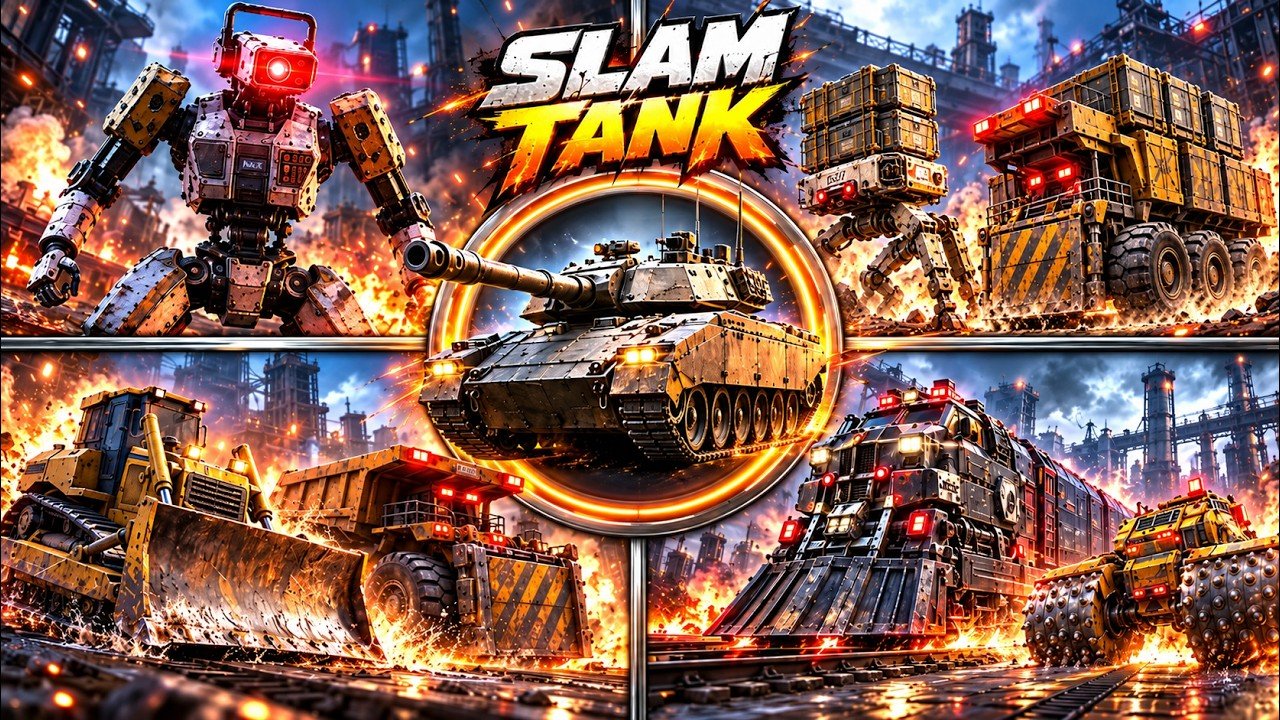
3. Entering the Turn: Drifting Gives Aggression a Curve
Movement acquires a changing orientation
A direct charge creates a simple relationship between origin and destination. Drifting complicates that relationship by introducing the impression of movement that exceeds straightforward pointing and advancing. SLAM TANK presents drifts as actions that can connect with attacks, making turning part of its combat identity. The important analytical possibility is that an approach need not culminate in a single straight-line collision. It can develop through a curve, with the vehicle changing its relationship to nearby targets as it moves. This does not establish particular handling rules, traction values, or damage bonuses. It indicates why drifting belongs conceptually beside melee: both make the tank’s changing position and orientation meaningful to the action.
The expressive value of a heavy object sliding
Drifting also introduces a useful contradiction. The tank’s appearance communicates weight, while a controlled slide communicates agility. Those qualities do not cancel each other. Their combination can make movement feel more forceful because the viewer recognizes an apparently substantial object being redirected. A lightweight object turning sharply may look ordinary; a large armored machine doing so creates a stronger impression of exertion. That impression is partly theatrical. It depends on the relationship between the object’s recognizable mass and the movement the game permits. SLAM TANK’s premise makes this exaggeration central to its tone. The tank is compelling because its actions stretch expectations while retaining enough of its armored identity for those expectations to remain relevant.
Curved movement can further change the perceived shape of a fight. Instead of treating an enemy as the endpoint of a straight approach, the player can understand it as something around which motion develops. An encounter becomes a relationship among trajectories, orientations, and possible contact surfaces. This is a conceptual account, not a description of a confirmed maneuver sequence. Its significance is that the tank’s movement can generate expressive variation before different weapons or enemy statistics enter the discussion. Two approaches toward the same opponent might communicate different intentions simply because one is direct and another bends through space. Drifting therefore supports the broader transformation of driving into performance: the route itself can become part of what makes an attack distinctive.
4. The Barrel Strike: Rotation Turns Space into Reach
An attack defined by an arc
The barrel strike is the clearest expression of SLAM TANK’s central reinterpretation. Rotation gives a long object a changing presence across surrounding space. Unlike a projectile, which separates from its origin, the barrel remains attached to the tank throughout the imagined action. The attacker and weapon remain visibly connected. That connection makes the geometry of the strike especially important to its meaning. The cannon’s length suggests reach, the turret suggests the center of rotation, and nearby opposition supplies a reason for the movement. No precise sweep angle or collision behavior needs to be invented to understand the appeal. The ordinary components of a tank become the visible ingredients of an unconventional melee gesture.
Why the connection between body and weapon matters
A physically connected strike can make force easier to attribute. The player sees a machine move a part of itself toward another object, and the resulting contact belongs to that visible action. This is different from saying that every contact must follow realistic physics. In an exaggerated action game, believable causality can exist without believable engineering. What matters is that the visual event provides an understandable explanation for the consequence. If the target reacts after the barrel reaches it, the action can communicate intention and result through one continuous relationship. SLAM TANK’s premise is particularly suited to that kind of clarity because the weapon is both conspicuous and inseparable from the vehicle that wields it.
Rotation also gives the tank a broader expressive field than a purely forward-facing attack would suggest. The player’s attention can extend around the vehicle rather than resting exclusively along its direction of travel. That introduces an interesting tension between driving and striking: movement carries the hull through space while rotation changes the barrel’s relationship to that space. Whether the finished game makes those actions highly independent or strongly coordinated remains a mechanical question. As a design idea, however, their coexistence is rich. The tank can be understood as a moving center from which an attack develops. Its offensive identity emerges from the relationship between the path of the vehicle and the space described by its attached weapon.
5. The Ram: When the Hull Becomes the Attack
Contact without an intermediary
If the barrel strike turns a vehicle component into a weapon, ramming goes further by making the vehicle’s main body the point of aggression. The developer identifies driving through enemy ranks as part of SLAM TANK’s core action. Conceptually, this removes the separation between the machine that moves and the instrument that hurts. The hull does not merely bring an attack into range; its arrival is itself threatening. That distinction gives forward motion unusual significance. The tank’s silhouette becomes a promise of occupation: it intends to enter a space that something else currently holds. Ramming expresses power as a dispute over physical position, resolved through the meeting of bodies.
Weight as an expectation rather than a measurement
The attraction of a ram depends partly on the weight the audience imagines. Players do not need a published vehicle mass to recognize a tank as substantial. Its visual identity supplies that assumption. A collision can then draw on the expectation that a large armored body should produce a meaningful reaction. This creates a demanding expressive contract. If a supposedly powerful contact receives an insignificant response, the tank’s apparent weight loses credibility. If every collision has identical consequences, differences among targets may become difficult to perceive. These are criteria for interpreting the design, rather than judgments about its implementation. The premise makes the response to contact especially important because the machine’s identity is being asserted through that response.
Ramming also changes the emotional structure of aggression. A distant attack allows the player to act while preserving separation from the event. A ram visibly commits the whole vehicle. Its meaning comes from involvement: the tank carries itself into the outcome it produces. This can make the action feel exuberant, reckless, or stubborn depending on context and presentation. It is an especially appropriate gesture for a game built around mechanical opposition, because both attacker and target can be understood as objects capable of resisting, colliding, and breaking. The central pleasure is therefore more specific than destruction alone. It is the spectacle of the player’s machine asserting its presence against another machine through an unmistakably physical act.
6. After Contact: Continuity Gives the Fight Its Rhythm
One impact creates the context for another
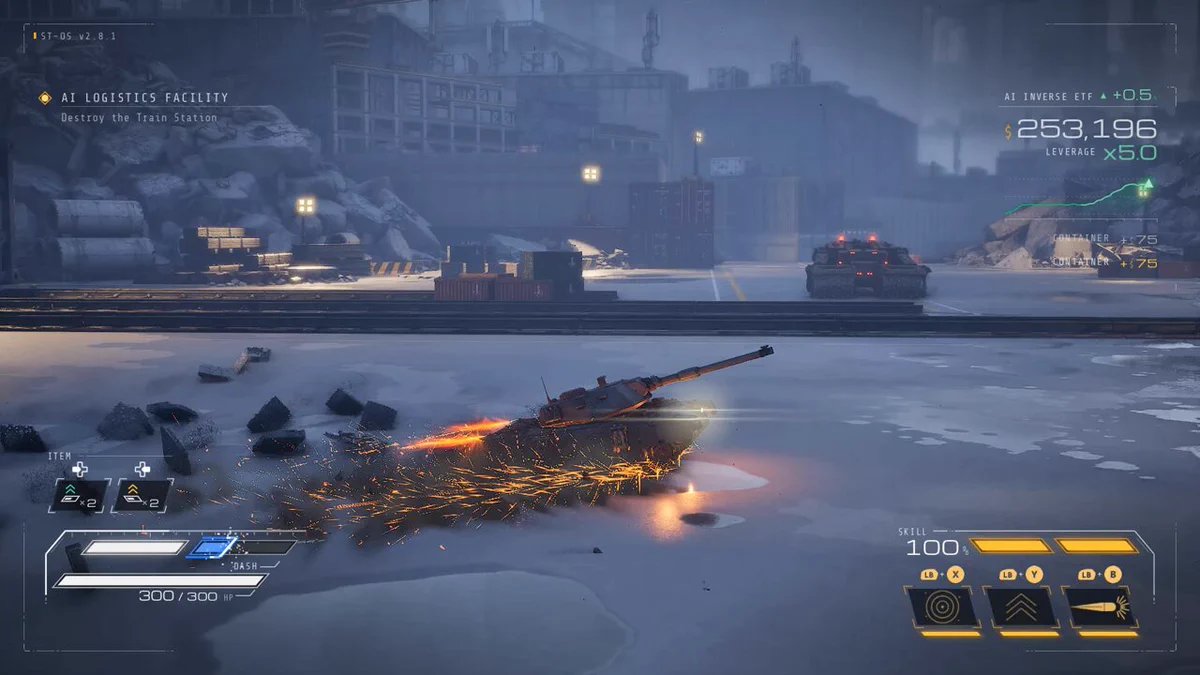
A single barrel strike or collision can establish the premise, but sustained action depends on what connects one event to the next. The developer’s presentation emphasizes combining movement, attacks, and abilities against groups. The analytical importance of that combination lies in continuity. If driving, striking, and repositioning feel like unrelated activities, the tank may seem to alternate between being a vehicle and being a fighter. If those activities connect coherently, the distinction becomes less pronounced. The vehicle can remain an active combat body throughout the encounter. This does not confirm a formal combo system, cancellation rules, or particular resource mechanics. It identifies the relationship that makes the advertised combination interesting.
Rhythm emerges from changes in purpose
Combat rhythm does not require every moment to have the same speed. An approach creates anticipation; a turn alters orientation; contact provides emphasis; subsequent movement changes the situation again. These functions can form a rhythm because each gives meaning to the next. Continuous action is therefore more than uninterrupted motion. It is motion whose purpose remains understandable as circumstances change. A vehicle can travel quickly while producing a monotonous encounter, just as a slower sequence can feel dynamic when each transition matters. For SLAM TANK, the distinctive opportunity is to make those transitions belong to the same armored body. The tank’s changing behavior can supply the encounter with structure without abandoning its mechanical identity.
Groups of enemies make that continuity especially significant. A lone opponent establishes a relationship between two bodies; several opponents create a field of possible relationships. Following one contact, the tank occupies a new position among remaining threats. That changed position can make the preceding action feel consequential even before score or damage totals are considered. The battlefield has been rearranged through the player’s movement. This is a useful way to understand the difference between spectacle that merely decorates action and spectacle that communicates change. A convincing sequence allows the audience to perceive why the next moment differs from the previous one. SLAM TANK’s moving-weapon premise is strongest conceptually when each collision leaves behind a new spatial situation.
7. Leaving the Ground: Jumps Expand the Tank’s Performance
The battlefield becomes more than a flat surface
Boost pads, jump ramps, and aerial tricks are among SLAM TANK’s advertised features. Their importance to the melee premise is not limited to adding speed or visual variety. Leaving the ground temporarily changes the relationship between the tank and the surface that ordinarily defines its movement. Tracks imply grounded traction; flight suspends that familiar connection. The resulting image extends the same exaggeration already established by drifting and barrel swings. The machine retains its recognizable form while behaving beyond the expectations attached to that form. It becomes possible to read the battlefield as a setting for performance, with movement carrying expressive value even outside the immediate instant of enemy contact.
The airborne interval creates anticipation
A jump has a natural dramatic structure: departure, suspension, and return. Once the tank is airborne, the audience anticipates where and how its apparent weight will meet the world again. That expectation can give an aerial movement significance without assuming any unconfirmed landing attack or impact bonus. The interest lies in the interruption of ordinary contact. A machine previously defined by pushing against the ground becomes an object moving through open space. Its eventual return restores the relationship between weight and surface. In a game organized around physical aggression, that temporary separation can make grounded movement seem newly forceful because the player has briefly experienced the tank outside its usual support.
Ramps and acceleration surfaces also imply that level geometry participates in the tank’s expressive vocabulary. The environment can invite a change in movement rather than merely constrain it. This relationship matters because a melee vehicle needs space that supports more than finding a firing position. Its surroundings can influence approach, direction, pacing, and spectacle. The available description does not justify claims about route complexity or the number of aerial opportunities in the full game. It does support examining the environment as a partner in the central fantasy. A tank that swings and rams becomes more coherent when the battlefield also accommodates exaggerated motion. Space then helps produce the performance instead of serving only as its background.
8. Meeting the Giant: Industrial Scale Tests the Fantasy of Force
The tank’s apparent size becomes relative
SLAM TANK’s developer describes encounters with massive industrial machines. Such opposition introduces an important change in perspective. Against smaller targets, the tank can appear to be the dominant physical presence. Against something much larger, the same vehicle becomes comparatively modest. The tank itself need not change for its meaning to change. Scale is relational: an object feels powerful partly because of the objects around it. This gives large opponents a function beyond having more durability or occupying more screen space. They can interrupt the assumption that armored weight automatically establishes supremacy, forcing the spectacle to consider what happens when the player’s machine encounters a greater visible claim to physical power.
Industrial forms give resistance a recognizable character
The term “industrial” is especially relevant to this interpretation. An industrial machine suggests work, infrastructure, and force directed toward a practical task. When such a machine becomes opposition, its ordinary associations can contribute to the encounter’s meaning. The player confronts an object whose apparent power derives from its function as well as its dimensions. This does not establish the behavior of any specific enemy, nor require inventing machinery absent from the published material. It explains why the category is evocative. A melee tank encountering industrial resistance resembles a confrontation between competing forms of mechanical purpose. The player’s machine turns motion into aggression; the opponent’s imposing structure suggests another organization of mass and force.
Large encounters can consequently become tests of the game’s central visual argument. The tank’s strikes must remain understandable when the target no longer appears easily displaced. A smaller collision may communicate dominance through obvious movement, while contact with something immense may require other forms of readable response. The precise solution belongs to implementation and cannot be settled from a feature list. The analytical point is that scale complicates the fantasy in a useful way. It prevents physical power from meaning only effortless superiority. The tank can remain forceful while encountering resistance that makes its actions appear deliberate, persistent, or defiant. That variation gives the moving-weapon concept room to develop beyond its initial comic surprise.
9. Counting the Wreckage: Destruction Becomes an Economic Statement
A score framed as someone else’s loss
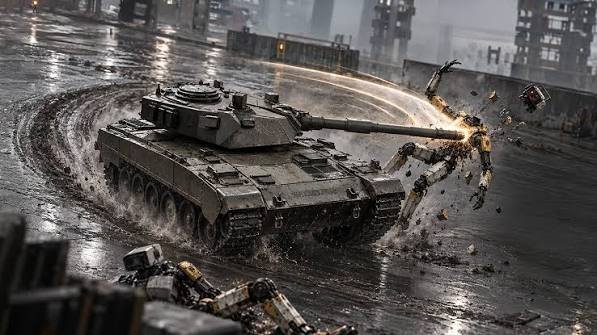
SLAM TANK frames its score as the cost of damage inflicted on the opposing AI’s machines, explicitly drawing attention to their computing components. This is a compact but meaningful choice. A number can measure performance without explaining what that performance represents. A damage bill gives the number an implied owner and an implied grievance. The player’s achievement is simultaneously the opponent’s expense. That framing links mechanical destruction to the fiction of resistance: each successful act reduces an adversary’s material resources. The score is therefore more than an abstract announcement that something desirable happened. It interprets the wreckage as an accumulating consequence for the intelligence directing the opposition.
The machine stops being an abstraction
An AI antagonist can be difficult to represent physically because intelligence does not possess one necessary visible form. A battlefield full of machines offers bodies through which that antagonist can act, but the scoring premise adds another connection. Those bodies represent investment, hardware, and replaceable capacity. Destroying one becomes an attack on the material conditions that permit the adversary to operate. This interpretation does not imply a simulated enemy budget or a persistent campaign economy; neither is established by the description. It concerns the meaning assigned to the score. The game makes technological opposition legible through financial loss, translating an otherwise diffuse enemy into objects that can be struck and costs that can be counted.
The economic framing also gives comic precision to an extravagant fantasy. Swinging a tank’s barrel at machinery is deliberately excessive. Treating the aftermath as an invoice makes that excess measurable in an unexpectedly mundane language. The joke depends on the distance between the scale of the physical event and the ordinary logic of accounting. At the same time, the tally can preserve the memory of action after its immediate spectacle has passed. A collision is brief; an accumulated total remains available for comparison. In this sense, the score connects fleeting contact to a longer experience of consequence. The tank’s movement produces an impact, the impact produces wreckage, and the wreckage receives a numerical interpretation that outlasts the moment.
10. Conclusion: The Meaning of a Tank That Fights with Its Whole Body
From recognizable vehicle to expressive combatant
SLAM TANK’s most distinctive idea is the relationship among its actions. A cannon swing reinterprets the turret as an attacking joint. A ram makes the hull’s arrival offensive. A drift gives an approach a changing shape. A jump suspends the machine’s familiar connection to the ground. Large opponents challenge its apparent physical authority, while a damage-based monetary score assigns lasting meaning to its destruction. Considered together, these elements suggest a coherent subject rather than a collection of unusual features: the tank becomes expressive through the ways its body moves into, around, and against resistance. Its identity emerges from contact and the anticipation of contact.
The design questions that follow the premise
The full significance of that idea ultimately depends on relationships that a public description cannot resolve. Perceived weight must coexist with readable movement. Spectacle must make consequences visible. Different situations must give repeated physical actions changing meanings. These are not reasons to dismiss the premise or predictions that it necessarily succeeds. They are the standards the premise creates for itself. The central questions can be stated clearly:
- Does the tank’s visible movement explain the force of its attacks?
- Do collisions meaningfully change the spatial situation?
- Can larger opponents create resistance without obscuring feedback?
- Does the destruction tally preserve a satisfying sense of consequence?
The lasting attraction of SLAM TANK’s concept is that its absurdity remains grounded in recognizable physical relationships. A long object can sweep through space. A heavy body can threaten whatever occupies its path. A moving machine can seem powerful because the world visibly responds to its arrival. By reorganizing those relationships around a tank, the game proposes a particular fantasy of agency: power expressed through committing an entire mechanical body to action. The cannon matters because it can become a gesture; armor matters because it gives contact apparent substance; movement matters because it carries intention toward consequence. That is the deeper promise behind the spectacle—a tank whose destructive identity is written through the motion of its whole body.