.webp)
How Accessibility Options Are Revolutionizing Gaming for Everyone
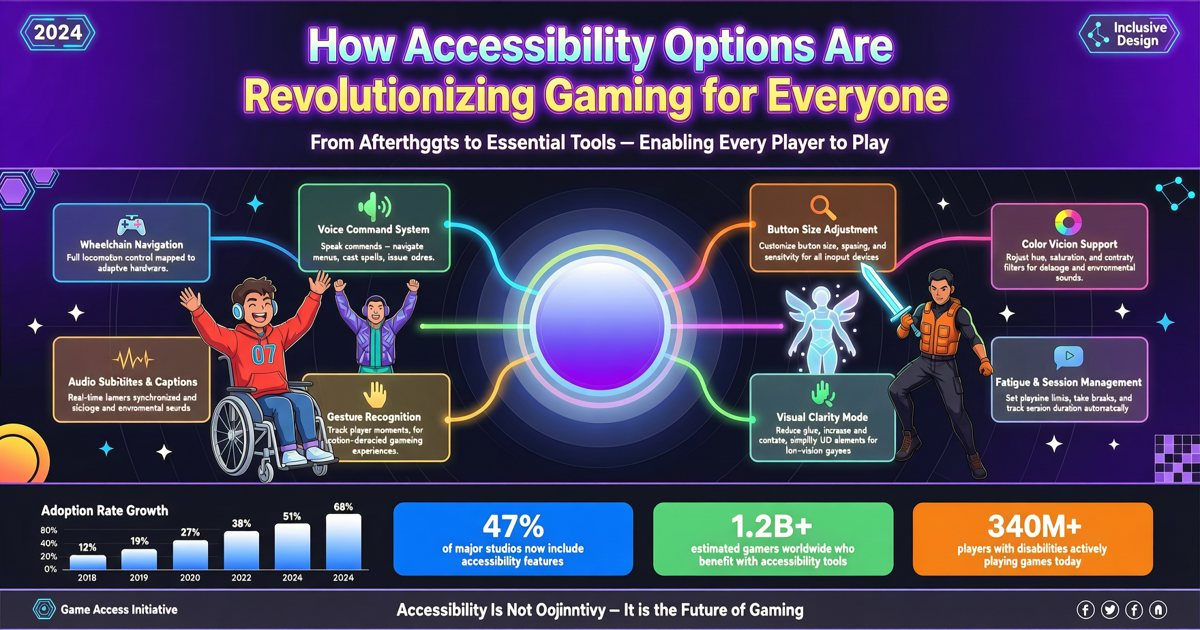
The Quiet Revolution: How Accessibility Options Are Changing Gaming

For decades, video games were designed with a one-size-fits-all approach, often alienating players with disabilities. But a quiet revolution is underway. Today, accessibility options are no longer an afterthought—they're becoming a standard feature in major releases, opening doors to millions of new players. This shift isn't just about ticking boxes; it's about fundamentally rethinking how games are made and who they're for.
The State of Accessibility: Then and Now
Not long ago, accessibility meant little more than a closed-caption toggle. Players with motor impairments, visual/hearing disabilities, or cognitive challenges often found themselves locked out of entire genres. But landmark titles like The Last of Us Part II changed the conversation, offering over 60 accessibility settings—from scalable subtitles to navigation audio cues and fully remappable controls. Since then, studios like Insomniac, Xbox (with its Adaptive Controller), and indie developers have followed suit.
Key Features That Make a Difference
Modern accessibility suites include:
- Visual aids: High-contrast modes, colorblind filters, large text options, and screen narration.
- Audio cues: Visual indicators for sound effects, directional subtitles, and speech-to-text for voice chat.
- Motor assists: Toggle versus hold, aim assist, auto-combo, and customizable button mapping.
- Difficulty options: Invincibility, slow-motion, or skip puzzle/challenge modes for cognitive accessibility.
These tools empower players to tailor their experience without compromising the core game design—a delicate balance that studios are learning to strike.
The Ripple Effect on Game Design
Beyond individual settings, accessibility is influencing level and mechanics design. Games like Celeste introduced Assist Mode, allowing infinite dashes and invincibility, while Forza Horizon 5 added sign language interpreters in cutscenes. This trend reflects a broader recognition that flexible design benefits everyone, not just those with disabilities. For example, subtitle customization helps non-native speakers or players in noisy environments.
Challenges and Criticisms
Despite progress, hurdles remain. Smaller studios lack resources to implement complex features, and some argue that too many options can dilute the intended challenge. However, the backlash is shrinking as players realize accessibility doesn't mean easing the game—it means removing barriers to entry. The cost of development is often cited, but advocates point to the vast underserved market: over 15% of the global population lives with some form of disability.
The Future: AI, Voice Control, and Beyond
Looking ahead, emerging technologies promise even greater inclusion. AI-driven dynamic difficulty could adjust in real-time based on player performance. Voice control and eye-tracking are already being integrated in games like Hellblade: Senua's Sacrifice and Microsoft Flight Simulator. The next frontier includes haptic feedback for deaf players and customizable UI that adapts to individual needs without requiring a deep settings dive.
Why It Matters

Gaming is a cultural force, and excluding people based on ability is no longer acceptable. The accessibility revolution isn't charity—it's innovation. When developers remove barriers, they enrich play for everyone. As more studios embrace inclusive design, we move closer to a world where anyone, regardless of ability, can experience the joy of gaming.
Whether you're a developer, a gamer, or somewhere in between, the message is clear: accessibility isn't a trend—it's the future of gaming.